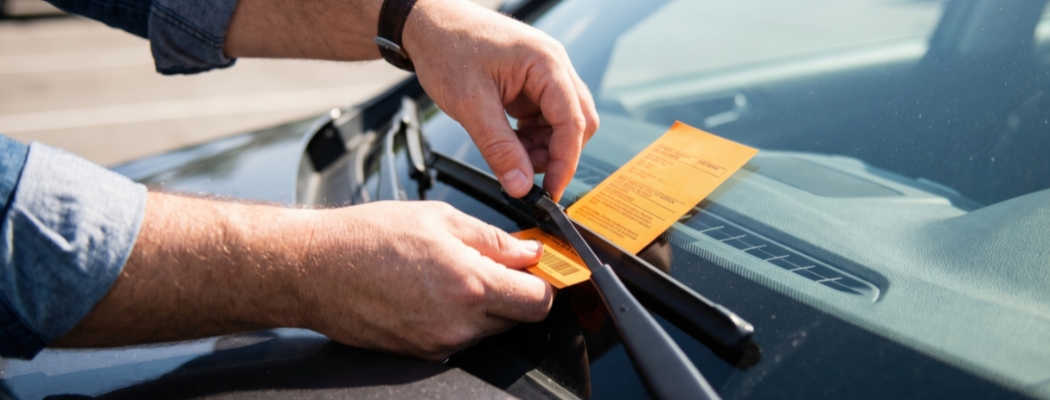
Obviously, nobody loves having to pay for parking. And it's completely understandable that nobody ever wants to find that official-looking piece of paper stuck under the wiper blade on their windshield.
For the vast majority of us, paid parking is a fact of urban life and a small fee to pay for peace of mind as we go about our day.
However, there are some individuals who have a tougher time abiding by the concept.
During our many years in parking enforcement, Concord has encountered all manner of tricks to avoid any sort of payment.
1. The Cover Up
Some bold drivers try to disguise their license plates to avoid identification. Tactics we’ve seen include:
- Covering plate characters with pieces of coloured tape or chewing gum
- Smearing mud or applying twigs and leaves to obscure the plate
- Using a marker to alter letters and numbers
- Bending or damaging plates to interfere with recognition systems
These efforts, far from subtle, often draw more attention than they deflect. Enforcement officers are trained to spot tampered plates, and suspicious alterations usually trigger closer inspection. Rather than avoiding penalties, these tactics frequently increase the likelihood of a ticket or further enforcement action.
2. Removing Plates Entirely
Another approach is removing license plates altogether. The logic is simple: no plate, no identification. However, this strategy backfires quickly.
Vehicles without plates are automatically considered non-compliant and are often subject to towing. Additionally, enforcement teams can still identify vehicles through their Vehicle Identification Number (VIN). Attempting to hide plates (when there is only one) by parking close to walls or backing into shrubbery and other obstacles is equally ineffective.
In short, removing or obscuring plates often escalates the situation from a simple violation to a more serious penalty.
3. Adding False or Misleading Elements
Some drivers attempt to confuse enforcement teams by introducing misleading details, such as:
- Displaying two different license plates on the front and back
- Leaving an old ticket on the windshield
- Using expired or irrelevant parking permits (hang tags or other visible ID)
- Submitting altered parking receipts
- Reporting on other parking customers and requesting their information
- Providing random photos of people and cars to dispute teams
These tactics rarely fool or distract experienced parking professionals. In fact, using mismatched plates may result in multiple tickets issued to the same vehicle.
Enforcement teams rely on systematic training, shared information in real time, and coordinated technology to identify suspicious inconsistencies and dismiss unjustified challenges.
4. Excuses and Last-Minute Claims
A common reaction when caught is to offer excuses:
- “I was only gone for a minute.”
- “The payment machine wasn’t working.”
- “I didn’t see any signs.”
- “But other people parked illegally too!”
- “I don’t even own that vehicle.”
- “I didn’t have a credit card with me.”
- “The information on the permit receipt was wrong.”
- “I didn’t exceed my allotted time. I drove off and came back to use it later.”
- “I paid for the wrong license plate.”
- “I really did pay for parking, but the machine never printed a receipt”
Most enforcement officers understand that delays in paying or returning to your vehicle can occur. Life happens! As such, some teams (like Concord Parking) will typically allow for a non-specified grace period before issuing tickets. Today’s advanced systems track precise timing, making it easy to verify how long a vehicle has been identified as being in violation.
Like other areas in life, ignorance of the rules (whether deliberate or not) rarely excuses the act. When in doubt about your parking options, never assume. And always make sure to hold onto that parking receipt for the entire length of your stay, even if you’re not required to place it on the dashboard!
5. Your Word Verses the Patrol Officer
 The next time you get a ticket, it is important to remember that most enforcement professionals aim to conduct their work in a fair and consistent manner based on the evidence available at the time. Nobody is out to get you.
People who deliberately make false claims about permit purchases or the official on-site may not be aware that there are behind-the-scenes parking enforcement administrators who can confirm notice details with complete accuracy. This is done through back-end verification portals.
By the time a ticket is issued, officers have clear evidence that the vehicle has well exceeded its allowed time. In addition, with established links between pay stations and enforcement software, parking officials can usually verify if there are any problems with the machines on site. In-field staff also document notices with detailed notes and photos.
As a result, common excuses rarely hold up—especially for repeat offenders whose histories are logged and accessible to enforcement staff.
6. After-the-Fact Receipts
Another familiar ruse involves obtaining proof of payment after receiving a ticket. For example:
- Buying a small item (like a cup of coffee from a food court) and producing the receipt to try to validate parking at a location reserved for customers only
- Paying for parking only after a ticket is issued and claiming there was a mistake
These attempts generally fail because enforcement systems record exact timelines and document potential issues extensively.
Even when free parking is in effect at shopping centers, it does not mean it allows unlimited parking for everyone. Time limits on parking in retail environments are important to ensure turnover of parking spaces, so patrons are more likely to find a place to park. A receipt obtained after the violation does not change the fact that the vehicle was parked without authorization.

Dispute teams are familiar with these scenarios and rely on documented evidence rather than post-incident claims. In most cases, these strategies are ineffective and only add unnecessary effort and cost for the driver.
Why These Tricks Don’t Work
The failure of these tactics comes down to two main factors: experience and technology.
- Experienced Enforcement Teams
Parking officers are trained to identify irregularities and suspicious behaviour. They document violations thoroughly, often with photos and detailed notes. Communication between team members ensures repeat offenders and known tactics are easily recognized. - Advanced Technology
Modern parking systems use tools like License Plate Recognition (LPR) and digital tracking to monitor compliance. These systems provide accurate timestamps and historical data, leaving little room for ambiguity. Attempts to manipulate or obscure information are usually ineffective against these technologies.
When Disputes Do Work
While most excuses fail, legitimate mistakes can happen. Drivers may have valid reasons for non-compliance, such as unknown technical issues or unclear signage. In such cases, dispute resolution processes do exist.
If parking becomes problematic, any reputable parking management company will appreciate having the issue brought to their attention.
Parking operators typically review each claim carefully, comparing it with their records and conducting an investigation.
First-time offenders with reasonable explanations may have a better chance of having their ticket reduced or dismissed as a first warning. However, deliberate violations or repeated offenses are unlikely to be forgiven.
The Big Picture
Attempts to bypass parking rules aren’t new.
As long as parking systems exist, there will be individuals who will try to exploit them. If these behaviours are allowed to continue unchecked, it creates a perception that the posted rules are optional. This situation can lead to frequent non-compliance, reducing parking availability for everyone.
Enforcement ensures that parking remains fair, accessible, and efficient. It protects the interests of property owners, municipalities, and compliant drivers alike.
Final Thoughts
While some drivers invest considerable effort into avoiding parking fees, these strategies almost always fail—and often result in greater penalties. The combination of trained enforcement personnel and modern technology makes it difficult to outsmart the system.
Ultimately, paying for parking or following posted rules is far easier—and cheaper—than attempting to get away with something underhanded. For those who genuinely believe they’ve received a ticket in error, dispute processes are available, and legitimate inquiries are welcome.
In the end, the simplest solution is the most reliable: follow the rules, pay when required, and avoid the potential headache of dealing with a fine altogether.